The Future of Stones - speculation on contaminated matter, 2016
Kunsthalle am Hamburger Platz, 2017, Berlin, DE
Project developed in collaboration with Professor Dr. Martin Kaupenjohann, the Institute of Applied Geosciences, and the Geochemical Laboratory at TU Berlin, Germany.
Materials that result from environmental contamination are emerging, and man-made materials, such as electronics, plastic, toxic waste are becoming part of nature. How will these human activities with significant global impact on earth‘s ecosystems affect the future of geology? This work is a speculation about stones in an imaginary geological future.


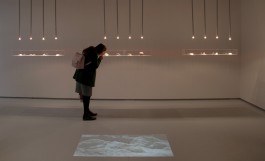
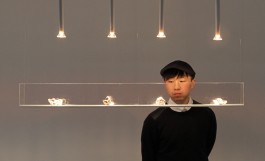
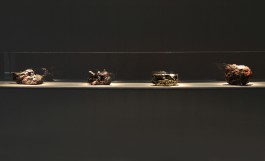
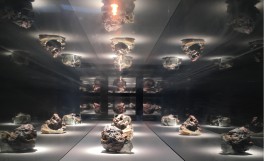
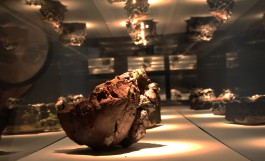
The Future of Stones - speculation on contaminated matter, 2016, Installation view and detail, glass display case containing Soil samples collected after the environmental crime in Mariana, Brazil, following an experimental simulation of rock formation processes, HD video projection, Kunsthalle am Hamburger Platz, 2017, Berlin, DE.
The Future of Stones - speculation on contaminated matter, 2016 HD video, 7.15 min.
The Future of Stones - speculation on contaminated matter
In the city of Bento Rodrigues, Brazil, on November 5th 2015, a mining dam broke causing the world‘s second worst environmental catastrophe of its kind. This event has affected the region and beyond in unpredictable and irreversible ways, leading to dramatic changes. This project engages in a speculative geology around the material outcomes of this happening.
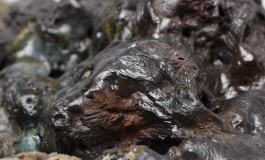
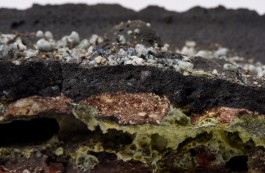
Samples of contaminated earth were collected from four different locations affected by the waste product released during the accident. They have empirically been experimented with on the development of a stone from the future - an aggregation of present earthly matters elapsed into a prognosis. Here stones are seen as media, which concentrate multidimensional information, specially on what concerns time.
The collapse in Bento Rodrigues represents a tendency that draws our times together. In this pseudo-alchemist speculative design, a post-human geology is illustrated, gathering worldly experience and projecting how Earth may unfold from here and now.
Project developed in collaboration with Professor Dr. Martin Kaupenjohann, the Institute of Applied Geosciences, and the Geochemical Laboratory at TU Berlin, Germany.
text by Monai de Paula Antunes, Published in Affen, Steine, Kühlerhauben | Mart Stam Preis Publication 2017 | Berlin, DE
The Future of Stones - speculation on contaminated matter, 2016, Installation view and detail, glass display case containing Soil samples collected after the environmental crime in Mariana, Brazil, following an experimental simulation of rock formation processes, HD video projection, Kunsthalle am Hamburger Platz, 2017, Berlin, DE.
The Future of Stones - speculation on contaminated matter
In the city of Bento Rodrigues, Brazil, on November 5th 2015, a mining dam broke causing the world‘s second worst environmental catastrophe of its kind. This event has affected the region and beyond in unpredictable and irreversible ways, leading to dramatic changes. This project engages in a speculative geology around the material outcomes of this happening.
Samples of contaminated earth were collected from four different locations affected by the waste product released during the accident. They have empirically been experimented with on the development of a stone from the future - an aggregation of present earthly matters elapsed into a prognosis. Here stones are seen as media, which concentrate multidimensional information, specially on what concerns time.
The collapse in Bento Rodrigues represents a tendency that draws our times together. In this pseudo-alchemist speculative design, a post-human geology is illustrated, gathering worldly experience and projecting how Earth may unfold from here and now.
Project developed in collaboration with Professor Dr. Martin Kaupenjohann, the Institute of Applied Geosciences, and the Geochemical Laboratory at TU Berlin, Germany.
text by Monai de Paula Antunes, Published in Affen, Steine, Kühlerhauben | Mart Stam Preis Publication 2017 | Berlin, DE